



UKREiiF | Reed, Ritchie share govt’s housebuilding strategy
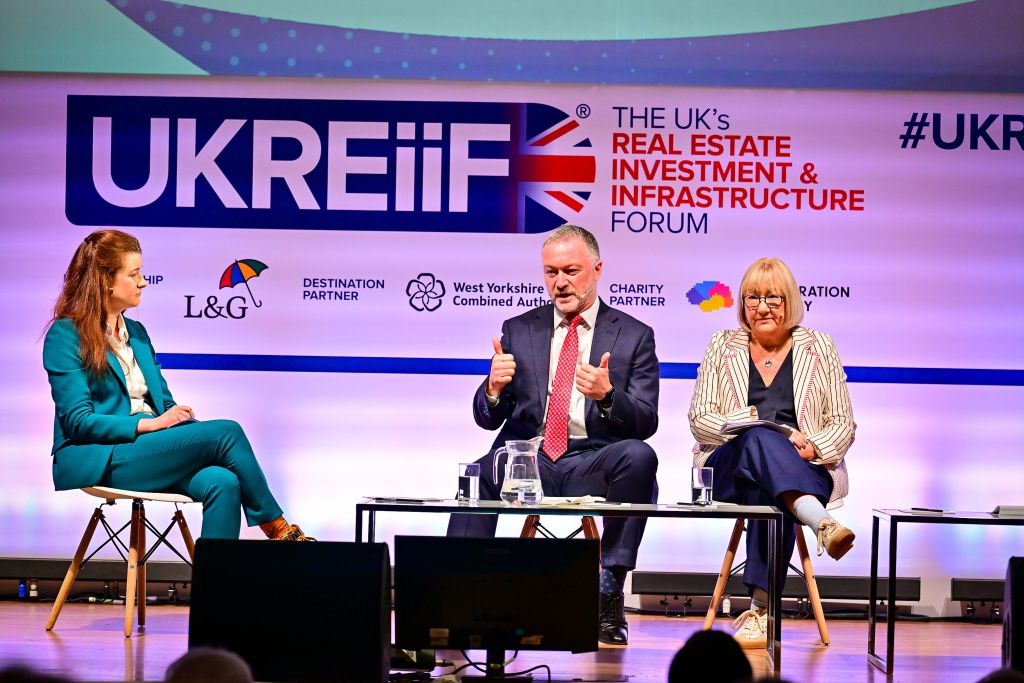
Voters made one thing abundantly clear in the local elections, according to secretary of state Steve Reed: “They want to see change faster.” At UKREiiF, he and Homes England chair Pat Ritchie shared how they were going to answer that call to action.
The two were speaking at the Leeds-based investment conference in a discussion chaired by Place North West editor Julia Hatmaker on Wednesday morning.
Elections and stability
Reed acknowledged that the results of the local elections, which saw Reform gain 1,452 seats and Labour lose 1,498 across the country, were “very difficult”.
“I would never underplay the scale of what happened then, but you have to reflect on what the voters have just said: they want to see change faster,” he said.
But changing leaders is not necessarily the answer – and neither is political infighting.
“If politicians do things that destabilise the investment community, then that pace of change is going to slow down and none of us can accept that,” Reed contended.
Reed reiterated that there is, right now, no challenge to the leadership of Prime Minister Keir Starmer. His focus is not on who may be the next leader, but on how to deliver the reforms promised.
“Our job is to get on with the job of work that the people of Britain, who are my boss, sent me and my colleagues to Parliament to do,” Reed said. “That is to get on with the business of government.”
He conceded that it was not “business as usual” though.
“It’s certainly not usual in the circumstances, but it’s business and we have to show the British public we are going to get on with the job that we were sent to do.
“The last government fell apart because of instability and constant chopping and changing,” he continued. “I think when you look at failure on that scale, you don’t repeat it.”
Momentum through partnership
Homes England has delivered more than 40,000 homes in the past year – the highest number of completions for the agency in six years. Ritchie said the key to this was partnership.
“Everything Homes England does is in partnership with the private sector, with housing associations, with local authorities, and with others,” she said.
“We really need to keep that moving, because there is momentum in the sector,” Ritchie added, acknowledging that there are challenges to meeting that desire for speed – including viability.
The National Housing Bank’s ability to use guarantees to unlock long-term funding was described as a “gamechanger”.
It leans into Homes England’s existing strengths in providing loans and equity investments to jumpstart development, and speeds up the process, Ritchie explained.
“It allows us to do it at scale and it allows us to do it in a much more flexible way,” she said.
There’s plenty of appetite too – with Reed noting that the £39bn Social and Affordable Homes Programme has already been oversubscribed. “It shows you the pent-up demand that there is. And we know that building social homes can stimulate the market as well,” Reed said.
As for when the programme will start awarding projects, Ritchie said Homes England would be making those decisions over the summer.
Demand-side interventions
Reed told the room that he knew they were anxious for the government to shift its attention from planning to demand and delivery. He said there were plans in the work to help with this and some, such as cuts to interest rates, that have already been enacted.
Progress is being made, Reed said.
“The final quarter of last year saw a 24% increase in housing starts,” he said. “That’s exactly the kind of trajectory we need to go on.”
Overseas events are impacting that, though, he continued.
“We know that we need to sit down and have conversations, myself with Pat with the Treasury and the sector, to make sure that we put in whatever further support is required to keep us going through what we hope will be a limited period of disruption – and then we can get back to the trajectory we need to be on to build the homes that we know can help speed up economic growth and also tackle the housing crisis we have in this country.”
Local authorities need to lead
Mayors need to be part of those conversations. Ritchie emphasised the benefits of having mayors at the table in discussions about placemaking. They know the area best and so Homes England has worked to build programmes around the priorities of mayors.
She pointed to the mayoral development zone in South Leeds as a prime example. Plans for the MDZ had been unveiled on Tuesday at UKREiiF by Ritchie, West Yorkshire Mayor Tracy Brabin, and Leeds City Council Leader Cllr James Lewis. These plans include around 20,000 homes alongside cultural destinations, commercial space, and substantial public realm. The zone will cover the city centre and parts of South Leeds Gateway.
“To deliver that, we’ve put together a joint team of Homes England, the combined authority, and Leeds City Council,” she said. “We work together every Monday and we are working on that project jointly using the best of our expertise.
“That’s a real collaboration,” she added.
It is also how she sees Homes England working in the future.
“We do national investment, but we are driven by local priorities and pipeline.”
Pride in place
Reed leaned into the concept of keeping locals involved in the work of Homes England and the government in placemaking.
“You’ve got to give local people a bigger say over things that are happening in their communities,” he told the crowd.
Ritchie made the case for joined-up thinking between government departments to help with this. This can also mean culture, too, she said, pointing to Sunderland, where Homes England helped deliver a bridge across the main football ground. This opened up the area between the city centre and the football ground.
“It’s just transformed that infrastructure and has enabled the change of that space,” Ritchie said. “We have delivered that with the city council and it’s their vision and their ambition that we’re getting behind in that connected way.”
Reed shared a cultural example of his own, pointing to Grimsby Town Football Club’s ability to draw in young people.
“You need anchors in communities that people can build out from to really develop a sense of pride and opportunity for the place they’re part of,” Reed said.
UKREiiF concludes today.