


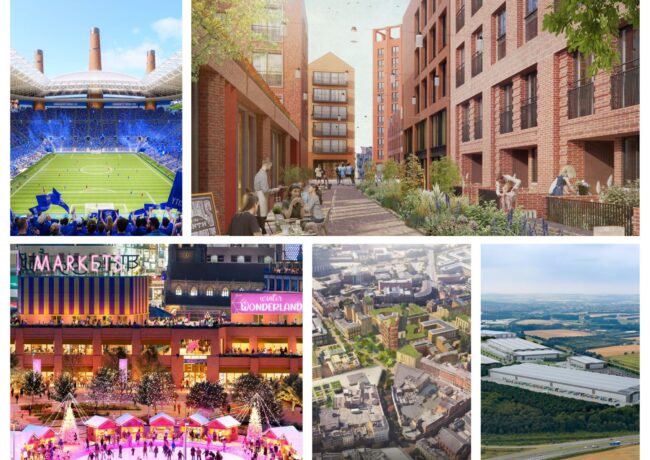
Coming soon | What we’re watching in 2026
From Birmingham’s multi-billion pound city-centre regeneration schemes to vast industrial and logistics parks across the region, the Midlands is heading into a pivotal year for development.
Several eye-catching schemes are due to move off the architect’s visioning board and the desks of the region’s planners, while others will move into delivery phases. The next 12 months will shape the region’s urban centres, employment hubs and transport corridors — and signal how far the Midlands can close the gap with its regional rivals.
In no particular order and purely based on what’s caught our eye, Place Midlands runs down some of the key projects set to move forward in our region over the coming year.
Smithfield

Birmingham’s Smithfield regeneration is due to get under way in 2026. Credit: Smithfield
To be honest, there are so many huge regeneration schemes in delivery in Brum it would be easy to fill an entire list with projects exclusively from the city – but with honourable mentions to the Knowledge Quarter, Digbeth and Curzon Street – there’s only one place to start on any list of what’s hot in 2026, and it’s at Birmingham’s largest and most high-profile city centre redevelopment project, where construction is finally due to get under way this year.
Billed as one of Europe’s largest regeneration schemes, the city’s near £2bn Smithfield project with Lendlease will see 3,000 homes and a new home for the Bull Ring Markets built in four phases over the next decade, after outline plans for the 42-acre site were unanimously approved by Birmingham City Council in June 2025.
Spades are already in the ground, in a sense, with archaeological digs under way in the latter part of 2025 aimed at preserving any remains of the city’s historic markets, which date back over 800 years.
The first phase of the scheme will include 408 build-to-rent homes overlooking Manor Square, and a new home for the city’s Bull Ring Market. Construction is expected to start on site in early 2026, with completion planned for 2027.
Alongside master planners Prior+Partners and David Kohn Architects, the design team working on the first phase includes dRMM and Intervention Architecture, Haworth Tompkins and Minesh Patel Architects and RCKa and Intervention Architecture.
Speaking after phase one proposals were granted planning permission in March, Cllr John Cotton, leader at Birmingham City Council, said: “This £1.9bn development will transform the area, creating a new community in the heart of our city.
“We are delighted to see these exciting proposals moving forward.”
Broad Marsh

Work on the redevelopment of Nottingham’s Broad Marsh area could begin in 2028. Credit: Nottingham City Council
Over to the East Midlands for another long-running city centre regeneration scheme which looks like it could finally get going in a meaningful way over the next twelve months.
Plans to regenerate the Broad Marsh area in Nottingham, which includes the vacant former Broadmarsh Shopping Centre, stretch back over two decades – but plans for 1,000 new homes and 60,000 sq ft of new retail space now look closer than ever to being realised after Homes England bought up the site last year in a de-risking exercise.
Demolition work on what remains on the former shopping centre is expected to get underway shortly, with Homes England on the lookout for a private-sector developer with a “proven track record to deliver transformational, exemplar city centre projects,” to drive construction on the scheme.
The project will also benefit from investment by the East Midlands Combined County Authority (EMCCA).
“The acquisition of Broad Marsh is a major milestone in the city council’s vision of regeneration for this area of Nottingham,” said Eamonn Boylan, chief executive of Homes England.
“We have worked closely with the council since 2022 to provide professional advice and support. Now that we have acquired the site, our teams will be working with partners to attract the right developer to deliver the new homes, employment spaces and leisure facilities necessary to create a vibrant city centre neighbourhood that the people of Nottingham can be proud of.”
Sports Quarter

Designs for a proposed new stadium for Birmingham City FC were published last year. Credit: BCFC/MANICA/Heatherwick
Back to Birmingham then, for a scheme which has possibly captured more national headlines than any other for the region in 2025.
In case you haven’t heard – and we realise it’s a pretty slim possibility – the city’s planned £2bn Sports Quarter, driven by Birmingham City Football Club and its American backers Knighthead Capital, will create a new 62,000 seat stadium for the football club at the former Birmingham Wheels karting site at Bordesley Green.
The project certainly created a splash when joint-architects Manica and Heatherwick released their initial designs late last year, which included a dozen huge chimney-style roof supports as the stadium’s signature feature – intended as a nod to the area’s industrial past.
Beyond the main stadium, plans released so far include a broad mix of uses including training facilities and academy spaces, community sports and leisure amenities, retail, dining and entertainment venues, new homes and improved public and green spaces, all set within a larger district designed to benefit local residents as well as visitors.
The project has received the blessing of the West Midlands Combined Authority too, who are building a tram line in its honour – with longer-term plans to extend services out as far as the airport and NEC.
We’re on tenterhooks waiting for a full planning application for the project, which is expected in the spring, and will surely include further juicy details. The club is hoping for a quick-fire approval from Birmingham City Council with a planned construction start slated for 2028.
Smithgate

A computer generated image of Wolverhampton’s proposed Smithgate development. Credit: ECF/City of Wolverhampton Council
Things are happening in Wolverhampton.
The city is gradually seeing some much-needed new residential development get under way, with over 500 homes now under construction at Wavensmere Homes’ Canalside South redevelopment on the former British Steel site at Qualcast Road.
But the city centre will get its biggest boost by far with the commencement of the city’s highest-profile development at Smithgate, a 1,000 home Build-to-Rent scheme near the city’s Market Square spearheaded by developer ECF and City of Wolverhampton Council.
Formerly known as City Centre West but renamed in honour of the city’s former metalworking industry, the project is the city’s largest regeneration scheme, with ECF envisioning a “transformative new quarter” for the city centre for the 12-acre site between Darlington Street and School Street.
Planning consent for the proposals was granted in March last year.
Contractors will break ground on the first phase of the scheme in 2026, known as the Bicycle Works, which will see 331 new homes built alongside new retail and public space on a currently vacant plot of land off Peel Street, overlooking Market Square.
The wider project will link the site with the Market Hall, and is expected to be delivered in phases over the next ten years.
Em.Ex
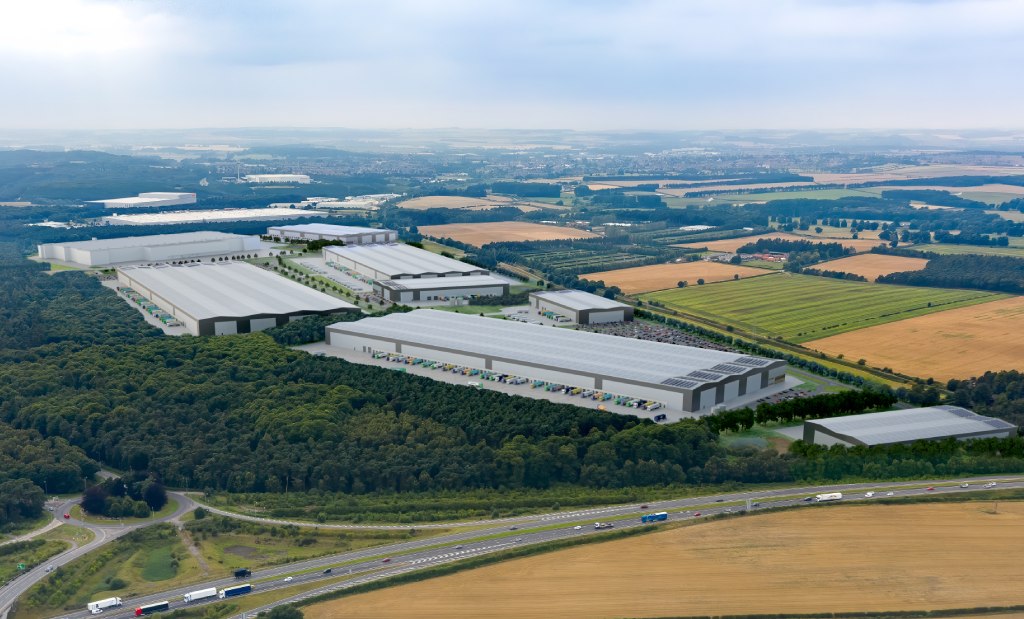
A 4m sq ft employment site near Worksop has been approved by planners. Credit: Caddick
The largest of the East Midlands’ industrial schemes to come forward in 2025, the first phase of Caddick’s 4.5m sq ft Em.Ex industrial and logistics hub at Workshop in Nottinghamshire will get underway early this year.
The first phase of the scheme will see a logistics unit with around 2m sq ft of floorspace built for an unnamed occupier, lined up in advance for the building, which Caddick says will represent a “notable statement of intent” for the scheme.
Planning approval for hybrid proposals was granted by Bassetlaw council in December.
The project team for the proposals consisted of Stantec as planning consultants, KPP as architects, FPCR for landscape and biodiversity, BWB for environmental services, Brookbanks as utilities consultants, and MBA for lighting and BREEAM advisory.
“Plot one alone could deliver approximately 2,000 jobs once the building matures, with upwards of 2,000-3,000 further jobs across the remainder of the site once fully operational depending on future occupier requirements,” said a planning statement on behalf of Caddick Developments.
“The development could therefore deliver a potential GVA to the district of £177m per annum, alongside multi-million pound business rates each year once fully operational. It would also deliver significant economic contributions during the construction stage with the potential to create over 800 direct and indirect construction jobs over a significant construction period.”