



Regeneration must create places, not just homes, says Muse MD
Town and city centre regeneration risks becoming ‘over focused’ on affordable housing at the expense of placemaking unless new funding mechanisms emerge, according to Muse managing director for the Midlands, Maggie Grogan.
Viability pressures and the disappearance of regeneration funding streams have made it increasingly difficult to deliver the mixed-use developments that have traditionally underpinned successful town and city centre transformation, she told Place Midlands.
Speaking about the challenges facing regeneration projects across the region, Grogan said the industry has welcomed recent government support for affordable housing – but warned that delivering successful places requires far more than homes alone.
Her comments come as Muse progresses a growing Midlands pipeline that includes major regeneration projects in Wolverhampton, Solihull, Arden Cross and Northampton, with the developer also eyeing opportunities across the East Midlands.
“We’ve always delivered mixed use, it’s what we stand for, but we’re finding that more and more difficult.
“I think people and local authorities are realising that town and city centres need to change, and they need to have people in them.
“Some of the most successful places that we see in the North West and London have people living there, but they also have that commercial ecosystem.
“You’ve got people spending money during the day, people spending money in the evening, people staying there. The potential is we’re going to lose some of that out of our towns because we can’t deliver commercial, leisure and retail because there’s no funding available for them.”
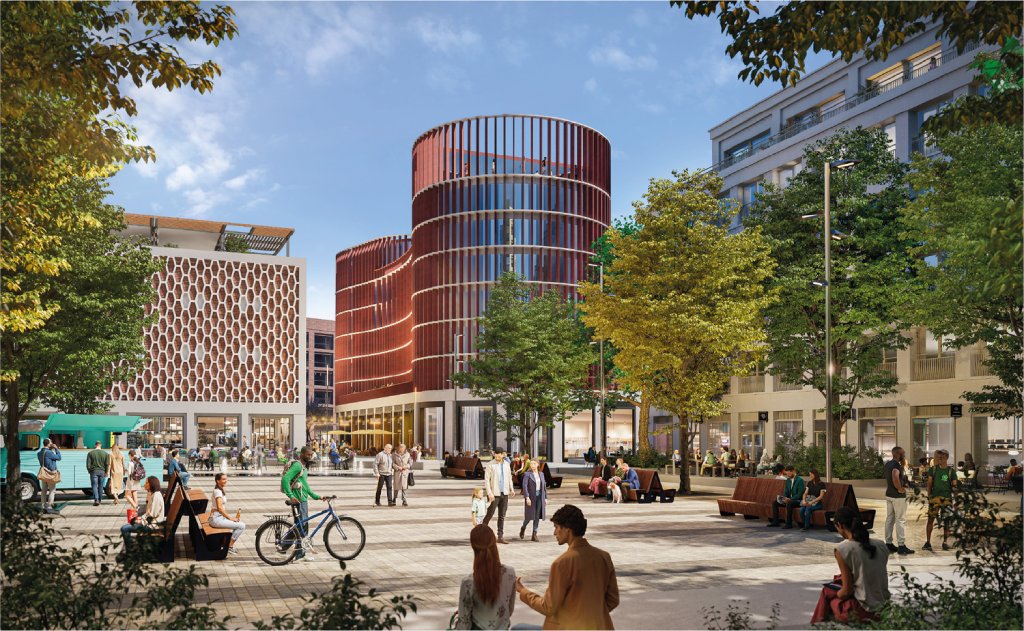
Holbeche Place in Solihull is set for a major mixed-use redevelopment. Credit: Muse
‘We need affordable housing, but it’s not the only answer’
That shift, she argues, risks undermining the very qualities that make urban regeneration successful in the long term.
“The worry is are we only focused on affordable housing? Areas need it and we really need a push on it, but it’s not the only answer to the housing crisis that we’ve got, and if we’re not delivering that mix of tenures, are we just creating a problem for ourselves in the future?” she added
“At the minute, across our pipeline, unless we’ve got a local authority involved from a funding point of view, we’re only delivering residential.”
The challenge is particularly acute in the office market, where rising costs and uncertain viability continue to suppress new development.
“Outside of London, we’re at the lowest level of office development for ten years,” Grogan said.
“Unless you’ve got a big pre-let and somebody’s going to come in and effectively pay to build it, nobody’s willing to build offices at the minute.”
The financial pressures facing local authorities have also fundamentally changed the way regeneration partnerships operate.
“Councils are so financially hamstrung that we have a very different relationship now,” Grogan said.
“Previously they might have been able to look at funding avenues or come alongside us and take an element of risk. That’s not happening anymore.”
Public-private partnerships are providing fresh opportunities for stalled sites
Despite those challenges, she believes there remains significant opportunity across the Midlands, particularly through long-term public-private partnerships capable of unlocking sites that have remained stalled for years.
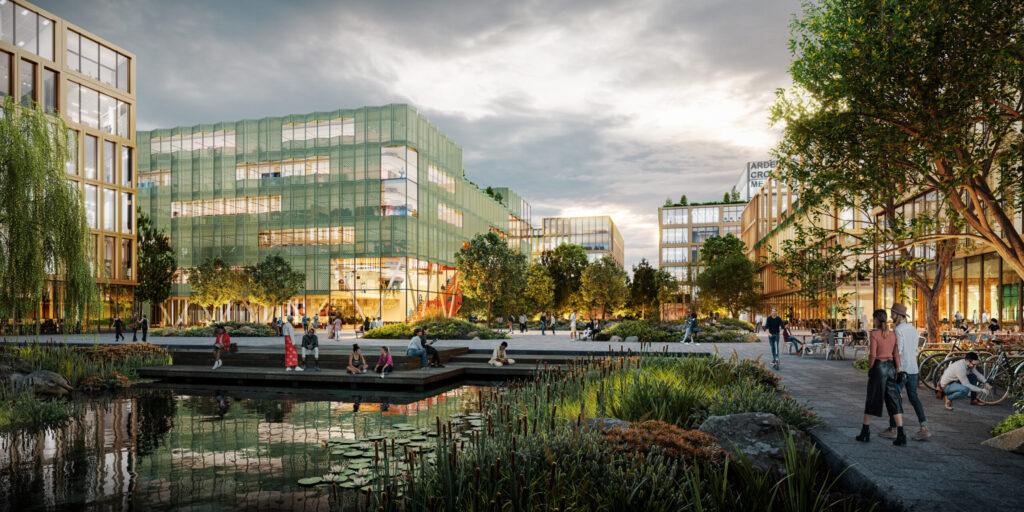
Arden Cross Ltd, Muse, and University of Warwick will now accelerate next stage of HealthTech Campus proposals. Credit: Muse/Arden Cross
The English Cities Fund, or ECF – a partnership venture between Homes England, Legal & General, and Muse – aims to unlock those trickier local sites by taking a longer term approach to place making, which she says is one way of solving a crisis of confidence at financially stretched local authorities.
“Often they’re coming to us with schemes that have been sat for a very long time, so that’s where ECF really comes into its own, because that in itself is a public-private partnership, that then goes and does public-private partnerships.
“So the longevity of ECF and the ability of ECF to look at things slightly differently and take that longer term view means that we can go in and unlock those places that have been stalled for a long time.”
Muse’s work in Solihull, where the developer recently secured planning approval for the first phase of the £1.5bn Holbeche Place regeneration scheme – which has also been backed by £20m of funding from the Mayor of the West Midlands and WMCA – reflects what Grogan describes as a shift from traditional regeneration towards “reimagining” town centres.
“We talk about it from a Solihull point of view as reimagining rather than regeneration,” she said.
“We always knew it was going to be slightly difficult in terms of kind of changing mindsets and changing the perception of what Solihull needs, but I think we’ve begun to do that.
“People are seeing that actually bringing people into the town centre is the right thing to do.”
Social uplift is the real marker of transformation
Looking ahead, the developer is also exploring opportunities in the East Midlands, with Nottingham, Derby and the wider Trent Arc identified as areas of particular interest.
“We see a big opportunity there,” Grogan said, highlighting growing ambitions around clean energy, innovation and economic growth.
For Muse, however, the ultimate measure of success extends beyond new buildings and investment figures.
Too often, Grogan argues, the industry focuses on assigning monetary values to social outcomes rather than demonstrating real impact.
“If we can tell the stories of people whose lives have been changed, apprentices who now have jobs, businesses we’ve helped to grow, that’s what real social value looks like.
“I guess we want to kind of almost ‘blend’ into the place because we it, and we understand the people, and we understand what the community wants.
“But I think we prove that our developments can be successful when people stop talking about them, almost when it’s just the norm and we’re delivering, and people are just like, ‘Oh, yeah, great, there’s another phase happening.’
“For me, that will be the real success of it – when people are just happy that we’re getting on with it.”