



Late contractor calls driving cost overruns, says Midlands construction boss
A culture of keeping contractors at ‘arms length’ during the early stages of major projects is a major cause of delays and cost increases, according to Midlands construction boss Paul Inions.
Inions, who is managing director at Midlands-based civil engineering and construction company McPhillips, believes there’s a structural problem with how most construction projects are procured, which the industry has so-far has been slow to confront.
He says that, despite years of post-project reviews, government-commissioned reports and frameworks encouraging collaboration, contractors are still routinely appointed after the critical decisions have already been made.
“Designs are finalised, planning applications submitted, budgets locked and then the team that actually has to build the scheme is brought into the room,” he said.
“It’s a sequence that feels logical from a procurement governance perspective, and it consistently produces worse outcomes.”
Inions understands why it happens. Design teams are appointed early and carry projects through RIBA stages under fee pressure, while clients are often cautious about committing to a contractor before a scheme is fully defined.
And there is a lingering cultural assumption that competitive tension, keeping contractors at arm’s length until tender, is the best way to protect value.
“In practice, it frequently does the opposite. You end up with a procurement process that feels rigorous but actually strips out the most valuable input at precisely the point where it would have the most impact.
“By the time a contractor is sitting across the table from a design team, the decisions that were hardest to reverse have already been made. The planning application is in. The specification is set. The budget has been presented to the board. At that point, you’re not managing risk – you’re managing consequences.”
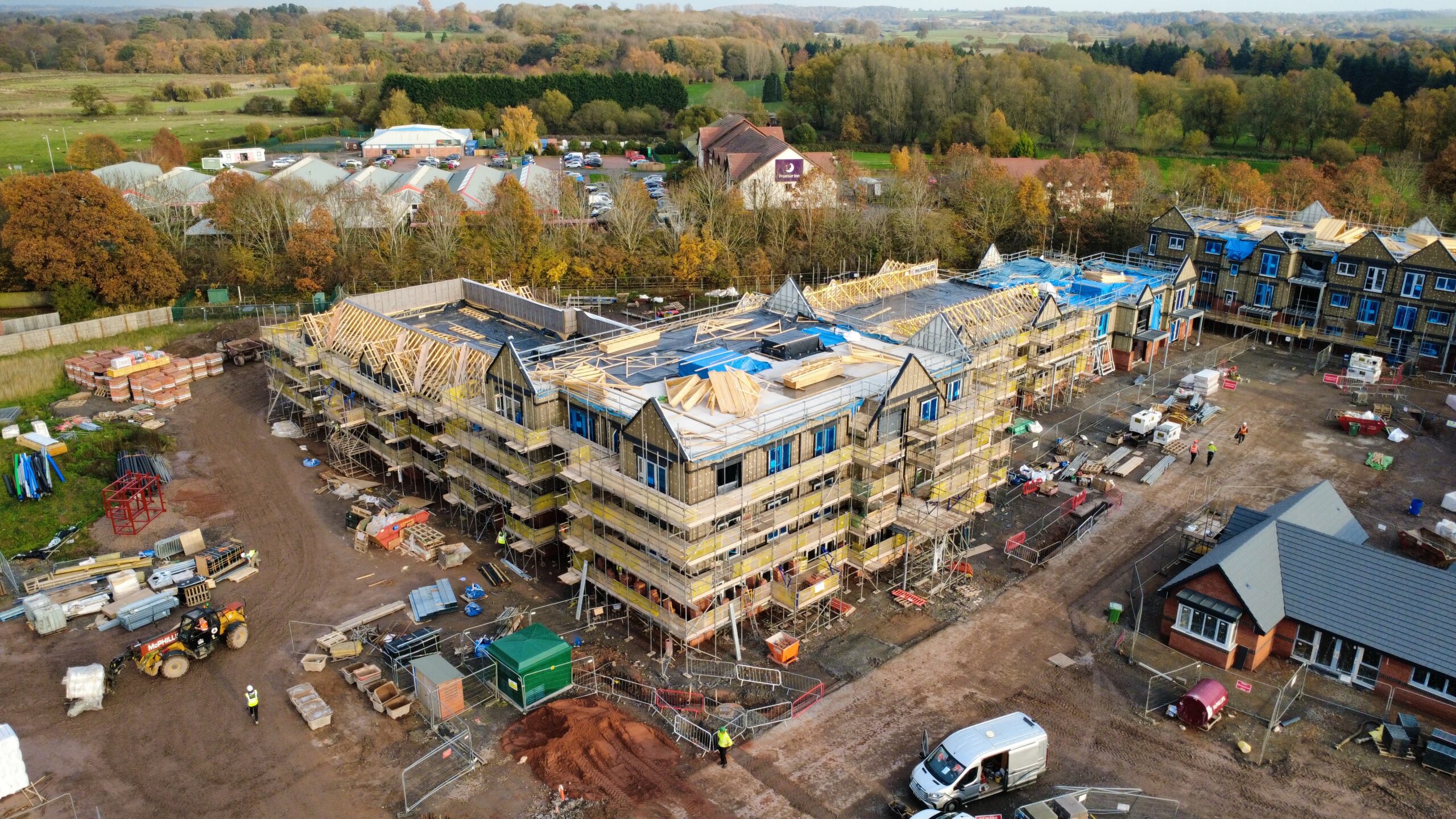
McPhillips celebrated a topping out ceremony at a new retirement community being built in Shropshire earlier this year. Credit: McPhillips
Inions believes the lesson from the UK’s most significant projects is not that construction is hard – it’s that complexity is consistently underestimated at the point when assumptions are being locked in.
He says Crossrail, HS2, and Hinkley Point C did not encounter their difficulties because of one dramatic mistake, but that late-stage systems integration, interface management and commissioning complexity proved far harder than original plans assumed.
“What those projects illustrate isn’t contractor error or poor site management,” says Inions, who is also Chair of the Midlands Constructing Excellence Shropshire branch.
“They illustrate the cost of information arriving too late. The complexity was always there, it just wasn’t visible to the people making the decisions at the point when those decisions still had room to flex.
“A contractor with experience of systems integration, of commissioning complex phased schemes, of managing interfaces between different work packages, would have seen those risks coming. That knowledge existed in the industry. It just wasn’t being asked for at the right moment.”
For complex, multi-phase schemes, the case becomes even more compelling.
McPhillips is currently working with later living developer Untold Living on a new retirement community in Newport, Shropshire — a scheme comprising 61 apartments and 15 bungalows, representing over £45 million of investment and more than 110 new jobs.
A 70-bed care home is being built on the adjacent site by a separate contractor, introducing an additional layer of complexity around logistics, sequencing and site management that simply does not exist on a standalone scheme.
“Understanding those realities early, how phases interact, where procurement lead times could affect programme, how site logistics evolve as work progresses next door, is what allows the whole project team to make informed decisions rather than reactive ones. If that complexity only becomes visible at tender stage, you are already behind. You’re pricing risk rather than managing it, and that difference shows up in the final cost,” adds Inions.
The shift towards two-stage tendering and ECI frameworks reflects a growing recognition that procurement models which prioritise competitive tension over collaborative input often destroy value rather than protect it. The CIOB and others have made this case at length.
Many clients, particularly in the public sector, default to single-stage competitive tender because it feels more defensible. Design teams, understandably, are protective of schemes they have developed through RIBA Stages 2 and 3.
“Design and build contracts are often assumed to change this, but in practice, they frequently just move the problem further down the line. Too often, a contractor is handed a partially developed design with key decisions already locked in, novated consultants who are protective of earlier choices, and a tender period that simply isn’t long enough to interrogate what you’ve been given. You’re still pricing risk you had no hand in creating – the contract just has a different name on the front.”
“The conversations that happen before planning goes in, about buildability, cost, programme and risk, are the conversations that determine whether a project succeeds. Having them earlier costs very little. Not having them early enough can cost a great deal.”